Tools Introduction Class
Tools Feature & Advantage Introduction Class
Tools Operation and Application Class
Tools Maintanence and Repair Class
Tools Quality Checking and Certified Class
Tools Torque Introduction
Marketing Service Area
Member post
Is More Torque Always Better? The Torque Multiplier Buying Guide: A Full Comparison of the 34488-26, 34688, and 3488B03MP
Popularity : 187When you′re dealing with bolts and nuts that need high torque, an ordinary hand tool often can′t deliver enough input force. That′s where a torque multiplier comes in — it amplifies input torque through an internal gear set, helping you complete high-torque tightening or removal work. Especially for outdoor jobs, or sites with no electricity or compressed air, a manual torque multiplier is often the only way to handle a high-torque bolt. But with a torque multiplier, bigger output isn′t always better. The ratio, input specification, working environment, operating method, and tool weight can all affect which one is actually right for you. This article uses the KING TONY 34488-26, 34688, and 3488B03MP as examples, working from real job requirements to walk you through how the models differ and what to consider when choosing one.
Core Specs at a Glance
Before choosing a torque multiplier, it helps to compare the basic specs of all three products.
| Spec | 34488-26 | 34688 | 3488B03MP |
|---|---|---|---|
 |
 |
 |
|
| Multiplication ratio | 26:1 | 5:1 | 64:1 / 4.2:1 |
| Max output | 4,500 Nm | 2,700 Nm | 6,400 Nm |
| Input drive size | 1/2" | 3/4" | 1" |
| Output drive size | 1" | 1" | 1" |
| Accuracy | ±5% | ±5% | — |
| Weight | 15.7 kg | 7.7 kg | 9.3 kg |
| Main accessories | Two reaction arms | Two reaction arms + limiter adapter | 32 / 33 mm sockets + adjustable support bracket |
As the specs show, the three multipliers differ in ratio, output capacity, input specification, weight, and accessory setup — so a real-world choice can′t come down to comparing maximum output torque alone.
A Closer Look at All Three: Which Job Site Are You On?
34488-26: High Torque with Accuracy
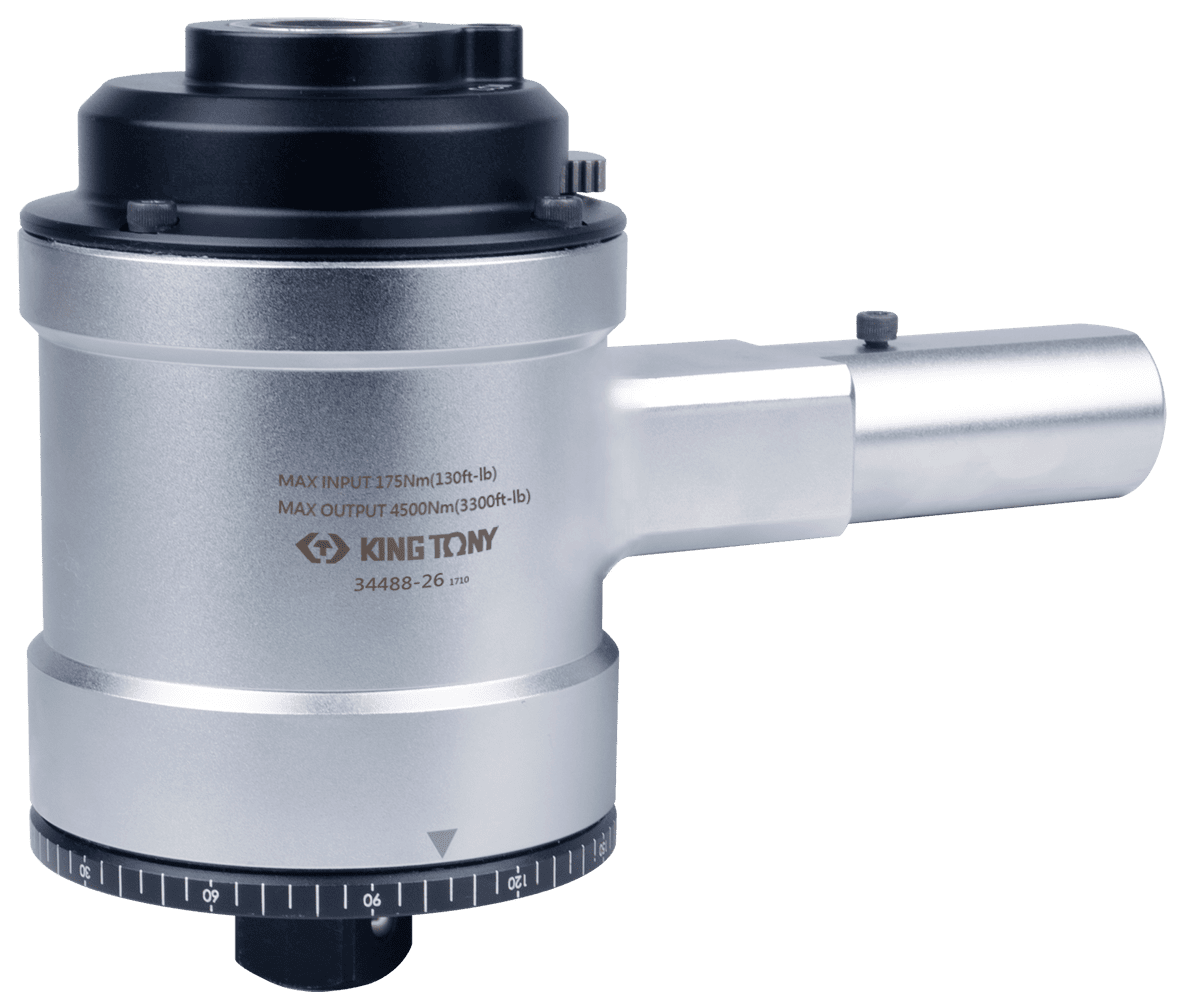
The 34488-26 uses a 26:1 ratio, delivers up to 4,500 Nm of output, holds ±5% accuracy, and has a 1/2" input drive and 1" output drive.
It′s a good fit for high-torque work that also demands torque control, such as:
- Industrial equipment assembly
- Pipe-flange bolt tightening
- Large equipment maintenance
- Other high-torque tightening or removal work
The 34488-26 comes with two reaction arms, so you can choose the one that fits the job site. During use, always confirm the reaction arm is braced firmly against a support point, so force transfers effectively.
A note on accuracy: if you′re pairing it with a torque wrench, don′t just look at the multiplier′s own ±5%. If the torque wrench itself has, say, a ±4% tolerance, the combined worst-case error can add up to roughly ±9%. So if a job needs tight control over the torque value, you also need to check the input tool′s own accuracy — not just the number on the multiplier′s spec sheet.
The right fit if:
"I need relatively high output torque, and the job requires torque control with a torque tool."
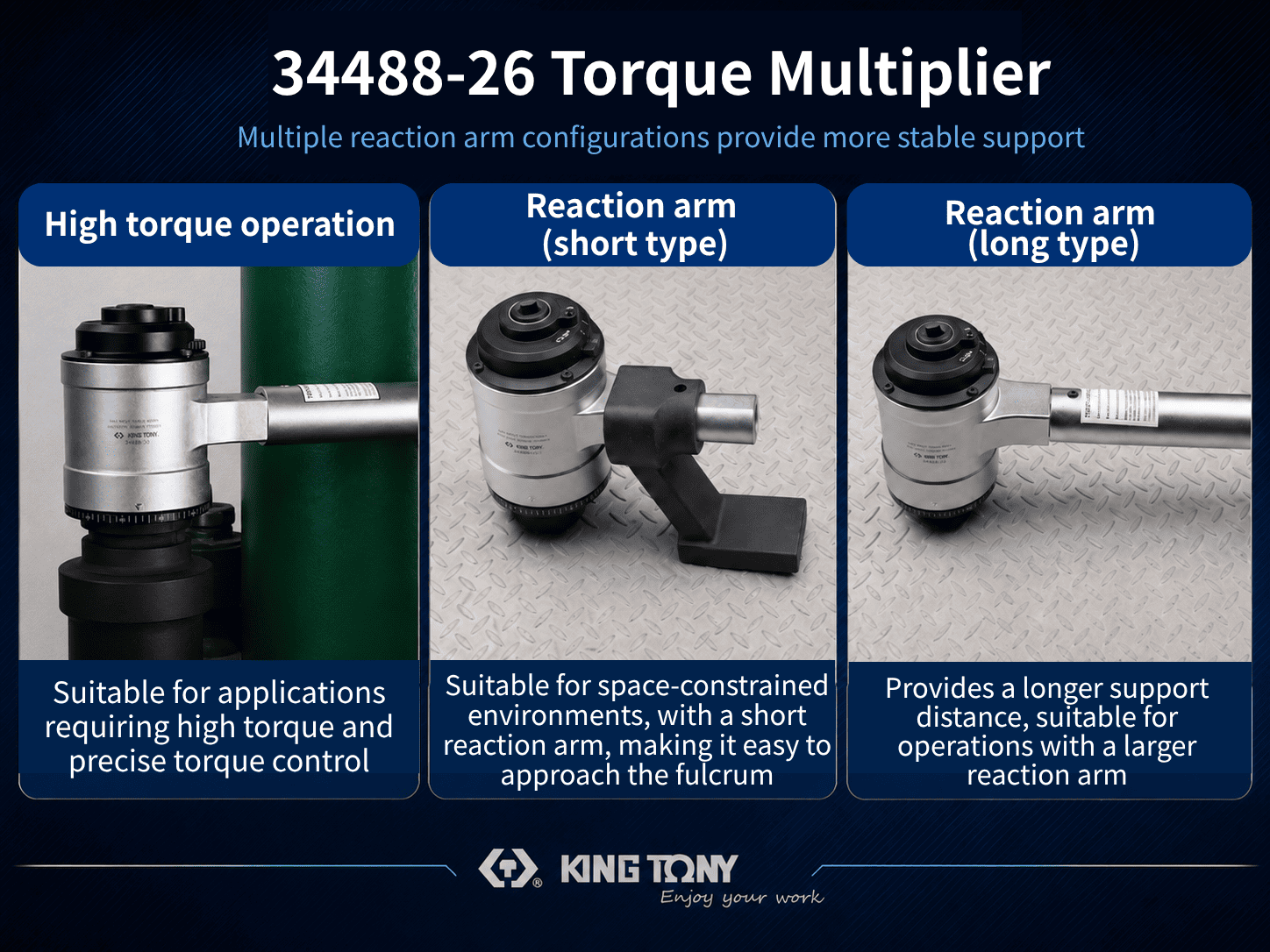
34488-26 feature image
34688: Lighter, for High-Torque Work That Means Moving Around
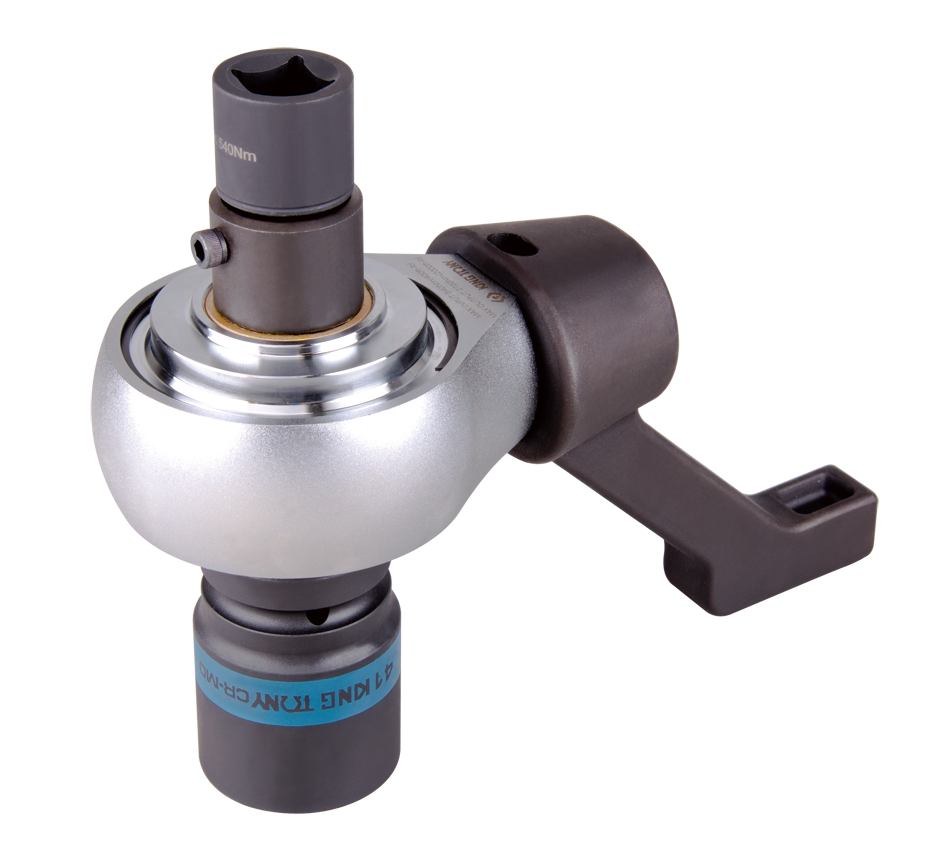
The 34688 uses a 5:1 ratio, delivers up to 2,700 Nm of output, holds ±5% accuracy, has a 3/4" input drive, and weighs about 7.7 kg.
For technicians who need to move a tool between different work positions, weight is a condition worth factoring into the choice.
The 34688 also comes with a Safety Adapter limiter rated to 540 Nm. When input torque reaches that limit, the adapter disconnects, preventing excessive input force from reaching the multiplier.
Check the Input Tool′s Specification
The 34688′s input drive is 3/4", so it should be paired with a 3/4" manual tool that matches the specification and load capacity.
Don′t just connect a 1/2" torque wrench through an adapter because it′s the only one on hand. The 34688′s maximum output is 2,700 Nm, and at a 5:1 ratio, the input end needs to withstand roughly 540 Nm — so the input tool itself must also meet that specification and load capacity.
The right fit if:
"My work needs high torque, but the output requirement is under 2,700 Nm, and the job requires torque control with a torque tool."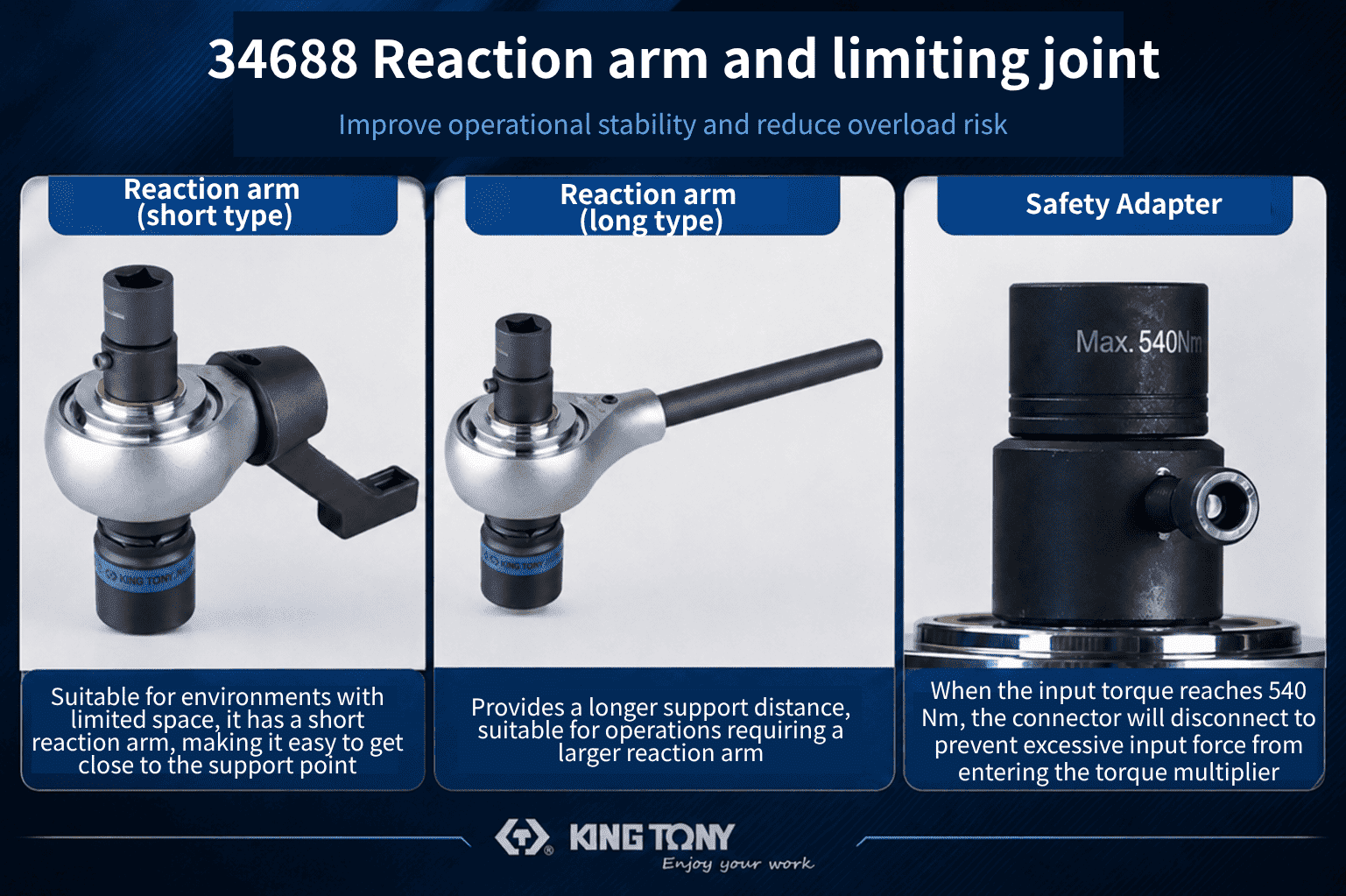
34688 feature image
3488B03MP: Heavy-Vehicle Wheel Service
If your work is mainly wheel service on trucks, buses, large commercial vehicles, or agricultural machinery, the 3488B03MP is built specifically for this kind of high-torque job.
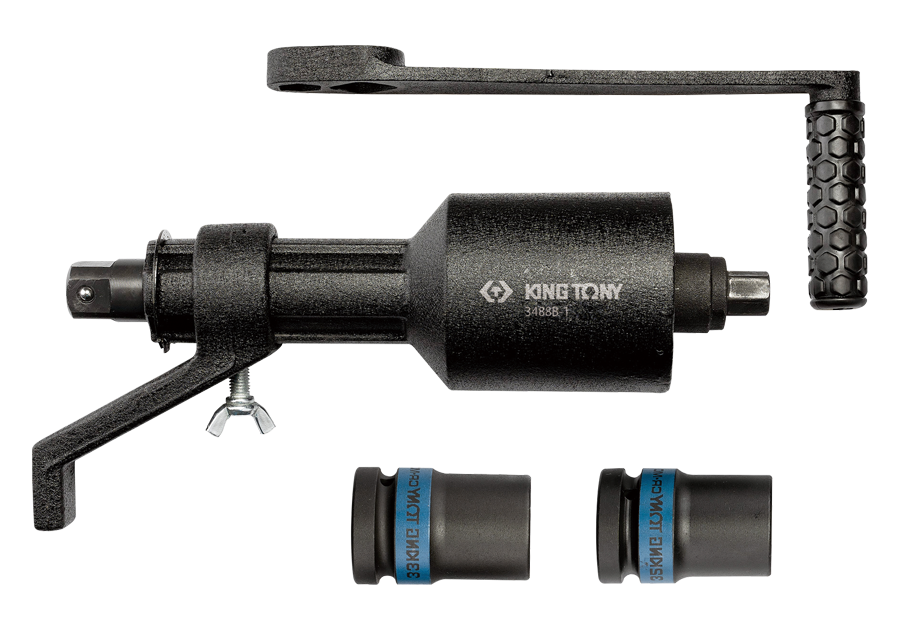
The 3488B03MP delivers up to 6,400 Nm of output, with a dual 64:1 and 4.2:1 ratio design, and comes with 32 mm and 33 mm sockets plus an adjustable support bracket.
Its design isn′t just about delivering more output torque — it′s about matching force and operating speed to different stages of the job, with three switchable modes:
64:1 | Breaking Loose
With a wheel nut that′s been torqued down a long time, the moment that needs the most force is usually right at the start, when it first gives. The 64:1 high ratio amplifies input torque to help break through a high-torque fastening.
4.2:1 | Spinning Off Fast
Once the nut is loose, there′s no need to stay on the high ratio. Switch to 4.2:1 for faster rotation, spinning off an already-loosened nut much more quickly.
1:1 | Direct Drive
When a job doesn′t need amplified torque — just direct transfer of the input end′s force and speed (for example, tightening an ordinary-torque nut, or quickly running one back down into position) — switch to 1:1 direct-drive mode. With no gear amplification involved, it′s more intuitive to operate and saves time.
So the simple way to remember it:
64:1 breaks it loose, 4.2:1 spins it off fast, 1:1 handles ordinary tightening.
The 3488B03MP′s support bracket also adjusts position, so it can be repositioned to suit different vehicles′ hub structures and find a suitable support point.
The right fit if:
"My work is mainly heavy-vehicle wheel service — I need strong breaking torque, want an already-loosened nut to spin off fast, and would like to handle ordinary tightening with the same tool too."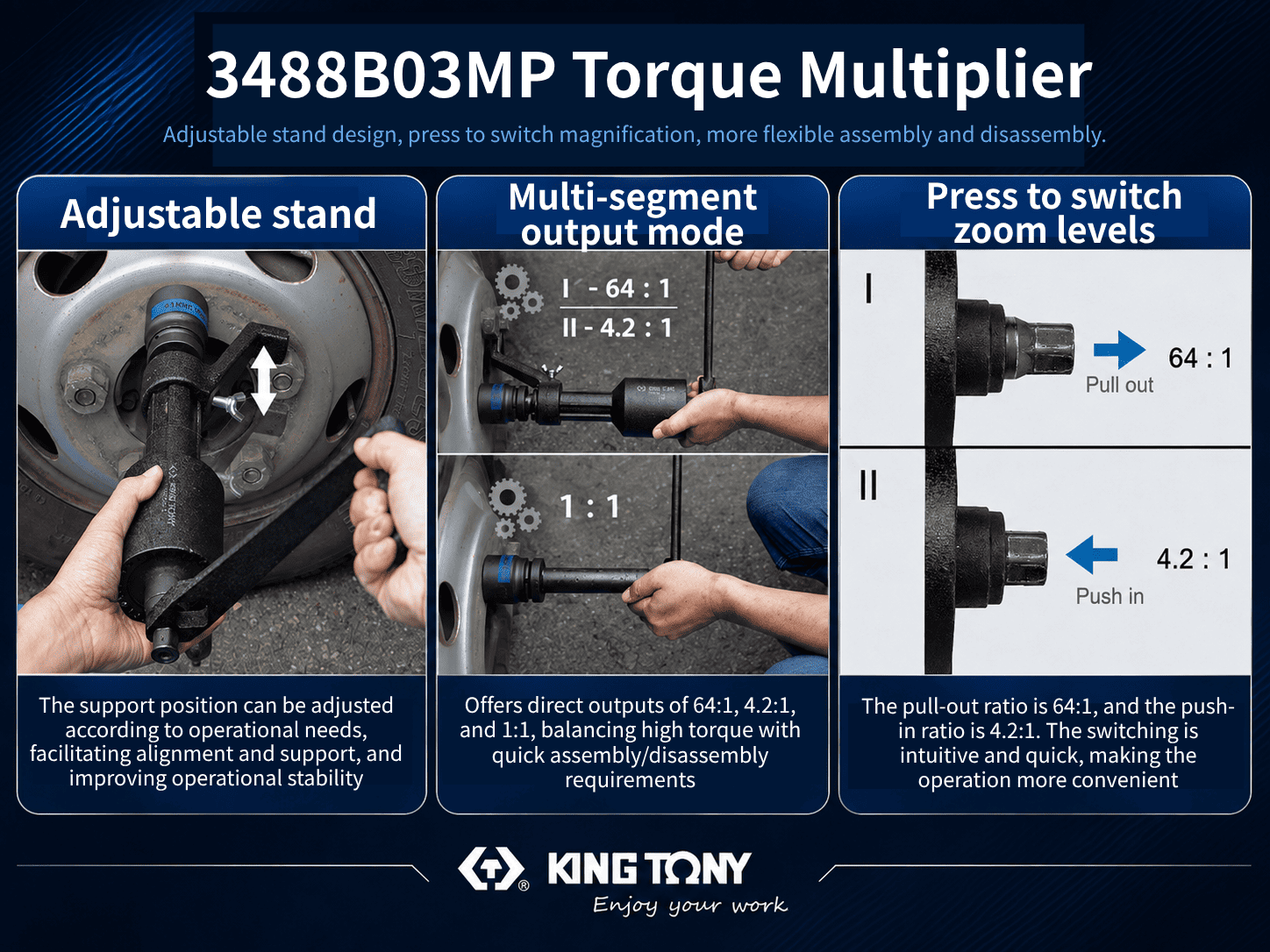
3488B03MP feature image
4 Keys to Choosing a Torque Multiplier
Now that you know all three products, the real question isn′t "which one is the biggest" — it′s which one fits your job.
-
Torque requirement
First, confirm how much output torque the actual job needs. If the job only needs 2,000 Nm, that doesn′t mean you have to reach for the 6,400 Nm model. Output capacity is just one factor — weigh it against tool weight, working space, and the job setting too. Confirm the requirement first, then pick the output range. -
Job setting
Different working environments call for different tool setups — industrial equipment, commercial vehicle maintenance, and heavy-vehicle wheel service each place different demands on ratio, weight, and accessories. See the "quick reference table" at the end of this article for a direct match-up. -
Operating method
Beyond maximum output, look at how the tool actually needs to be operated on the job. Take the 3488B03MP′s multi-ratio design as an example — it′s built for different stages of the job: high ratio when you need force, then low ratio or even direct drive once the nut is loose. So ratio isn′t just "the bigger the number, the better" — it comes down to whether the actual job calls for force or speed. -
Tool specification and support conditions
Finally, confirm two more things:Input/output specification: confirm whether the multiplier′s input and output drives will work with your existing manual tools and sockets. 34488-26 → 1/2" input, 1" output / 34688 → 3/4" input, 1" output / 3488B03MP → 1" input, 1" output. Also confirm that the input tool′s and socket′s load capacity meet the actual job requirement.
Support conditions: as a torque multiplier amplifies torque, the tool body also takes on a reaction moment. Before operating, confirm the reaction arm or support bracket can be braced firmly against a solid support point, with a contact surface that′s as flat and wide as possible, and the reaction force direction as close to a right angle to the arm as possible — to avoid the support point slipping or uneven loading.
Quick Reference: Which One Should I Actually Get?
| Industrial high torque + torque control | 34488-26 |
| High torque + lighter weight + torque control | 34688 |
| Heavy-vehicle wheels + high-torque removal, fast spin-off | 3488B03MP |
| Outdoor work, high-torque manual jobs with no electricity/compressed air | All three can work — depends on the actual torque requirement and job setting |
That said, this is only a first-pass filter. In the end, always confirm the actual torque requirement, the input tool′s specification, and the on-site support conditions.
FAQ
Q1: The 34488-26 and 34688 can both be paired with a torque wrench — which should I choose?
It mainly comes down to the actual output torque you need and the tool′s weight: if your requirement is under 2,700 Nm and you need to move the tool often, the lighter 34688 fits better; for a higher requirement or tighter accuracy control, the 34488-26 is the better fit.
Q2: Can the input tools for the three multipliers be used interchangeably?
No. All three have different input drive sizes (1/2", 3/4", 1"), so each needs an input tool that matches its specification and load capacity — you can′t just force a connection through an adapter.
Q3: Do I always need the model with the highest output torque to be safe?
Not necessarily. Output torque should match the actual job requirement — choosing a model that far exceeds what you need adds cost and weight without making the operation any safer.
Q4: What does the 34688′s limiter adapter (Safety Adapter) do?
When input torque reaches the 540 Nm limit, the adapter disconnects, preventing excessive input force from reaching the multiplier — it′s a safety mechanism that protects both the tool and the operator.
Q5: Are the reaction arm and the support bracket the same thing?
They serve a similar function — both resist the reaction moment generated as the multiplier applies force — but the design differs: the 34488-26 and 34688 use reaction arms, while the 3488B03MP uses an adjustable support bracket.
Conclusion: Choose the Right Tool for Easier High-Torque Work
From the basic principle of a torque multiplier, to how to release residual torque when it′s stuck, to real-world use on heavy-vehicle wheels — a torque multiplier isn′t just about amplifying torque. What matters more is getting high-torque work done the right way. The 34488-26, 34688, and 3488B03MP each match a different job requirement and use case. Understanding how each tool is designed and used is what lets you make the right call when a different high-torque job comes up. We hope this series helps you, next time you run into a large bolt or nut, think not just "I need more force," but know how to choose the right tool and operate it correctly — for work that goes more smoothly.