Tools Introduction Class
Tools Feature & Advantage Introduction Class
Tools Operation and Application Class
Tools Maintanence and Repair Class
Tools Quality Checking and Certified Class
Tools Torque Introduction
Marketing Service Area
Member post
Truck Wheel Nut Seized and Won′t Budge? 64:1 to Break It, 4.2:1 to Spin It Off — How to Use a Heavy-Duty Torque Multiplier|3488B03MP
Popularity : 1041Wheel nuts on trucks, buses, and other heavy vehicles are large and torqued down hard — and after long service, they can become even harder to remove. In situations like this, relying on an ordinary hand tool alone often means an enormous amount of manual effort.
The 3488B03MP is a torque multiplier set designed specifically for wheel service on trucks, buses, agricultural machinery, and other heavy vehicles. Beyond delivering up to 6400 Nm of output torque, its key feature is a built-in dual ratio of 64:1 and 4.2:1, letting the user choose the right approach based on the current condition of the nut.
Why Do Heavy-Vehicle Wheels Need Two Ratios?
Removing a wheel nut on a heavy vehicle can really be thought of as two separate jobs:
The first job is "breaking" a seized bolt or nut loose.
The second job is spinning it off quickly once it′s loose.
These two stages call for completely different amounts of force and speed, which is exactly why the 3488B03MP is built with two ratios — so the tool can switch to match the stage of the job.
64:1 — High Ratio, for "Breaking It Loose"
With a wheel nut that′s been torqued down for a long time, the hardest part is usually that very first moment it starts to give. What that moment calls for is more output torque — not rotation speed.
Switching to the 64:1 high ratio amplifies torque from a relatively small input force, letting the 3488B03MP deliver up to 6400 Nm of output.
For example, a 100 Nm input, run through the 64:1 ratio, theoretically yields 6400 Nm of output.
64:1: for powerfully breaking a bolt or nut loose.
4.2:1 — Low Ratio, for "Spinning It Off Fast"
Once a bolt or nut has come loose, there′s no need to stay on the 64:1 high ratio.
Keep spinning at the high ratio and you can still turn the nut, but it′ll be slow going. Switch to the 4.2:1 low ratio instead, and you get faster rotation — spinning off an already-loosened nut much more quickly.
4.2:1: for quickly spinning off a nut that′s already loose.
So here′s the simple way to remember the 3488B03MP′s two ratios: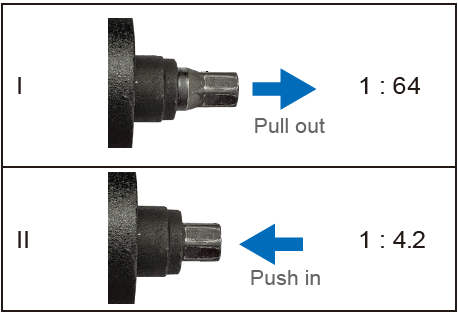
64:1 breaks it loose, 4.2:1 spins it off fast.
How Do You Switch Between the 3488B03MP′s Three Modes?
Besides the 64:1 and 4.2:1 ratios, the 3488B03MP also offers a 1:1 direct-drive mode, so you can switch based on what the job needs.
| Mode | Ratio | Main Use |
|---|---|---|
| High ratio | 64:1 | Breaking a seized nut loose |
| Low ratio | 4.2:1 | Spinning off a loosened nut quickly |
| Direct drive | 1:1 | No amplification — transmits input force directly |
You switch ratios using the shaft on the tool body:
-
Pull the shaft out → 64:1
Used for the breaking-loose stage, when high torque is needed. -
Push the shaft in → 4.2:1
Once the nut is loose, switch to the low ratio to spin it off quickly. -
Pull the shaft all the way out → 1:1
Used as direct-drive mode.
In practice, choose the ratio that matches the nut′s current condition — don′t just stay on the highest ratio the whole time.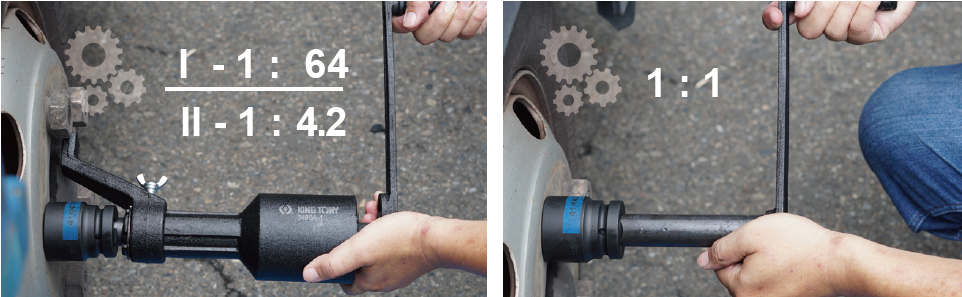
What Does the Adjustable Support Bracket Do?
With a torque multiplier, output torque isn′t the only thing that matters — how stably the tool is supported matters just as much.
As a torque multiplier applies force, the tool body also takes on an opposing reaction moment. That′s why a support bracket needs to be braced against a solid support point, so force can transfer effectively to the nut.
But the hub shape and surrounding structure aren′t the same across every heavy vehicle. A fixed support position won′t necessarily fit every vehicle′s situation.
The 3488B03MP comes with a support bracket that adjusts forward and back, so you can reposition it to suit different vehicle models and hub structures and find a support point that′s stable and appropriate.
This keeps the tool steady during high-torque work and reduces the misalignment that comes from an ill-fitting support position.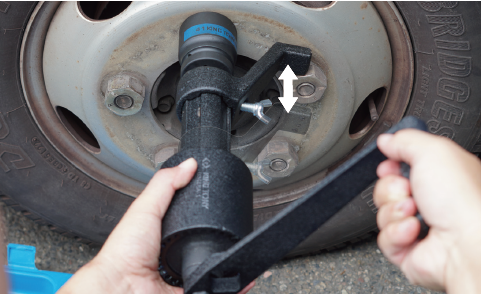
The support bracket isn′t just there to prop the multiplier up — it′s there to resist the reaction force generated during operation.
How Do You Choose Between the 32 mm and 33 mm Sockets?
The 3488B03MP set comes with both a 32 mm and a 33 mm socket, so you can select the one that matches the actual nut size.
Before use, confirm:
Nut size → select the matching socket → mount the multiplier → confirm the support position → begin applying force
Don′t use a socket just because it "sort of fits." The socket size needs to properly match the nut for force to transfer reliably.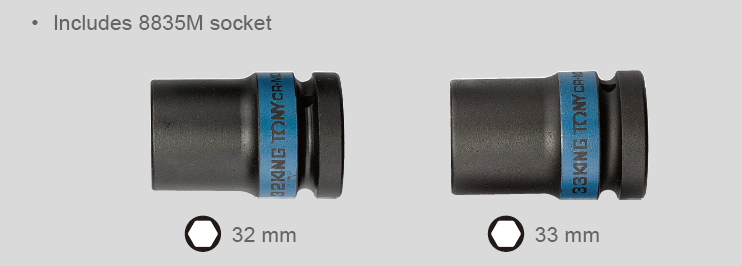
Which Heavy Vehicles Is the 3488B03MP Suited For?
The 3488B03MP is designed mainly for wheel service on heavy vehicles, such as:
- Trucks
- Buses
- Large commercial vehicles
- Agricultural machinery
This kind of work usually calls for higher torque, and wheel service often means dealing with nuts that have been torqued down for a long time and are hard to remove — so the multiplier′s high-ratio output helps get through the higher-torque removal work.
Once the nut is loose, switching to the low ratio to spin it off quickly cuts out unnecessary operating time.
Why Isn′t "Higher Ratio, Always Better" for Heavy-Vehicle Wheel Removal?
Seeing 64:1, a lot of people′s first thought is:
"Why not just use 64:1 the whole time?"
Not necessarily.
A high ratio′s advantage is raw power, but once a nut is already loose, there′s no need to keep chasing maximum output torque.
That′s why the 3488B03MP puts both ratios in a single tool:
When you need power, use 64:1.
When you need speed, switch to 4.2:1.
This design isn′t just about adding a feature — it′s built around the two distinct stages of heavy-vehicle wheel service: "breaking loose" and "spinning off fast."
3488B03MP Key Points
If you only remember a few things from this article, remember these:
-
① 64:1 is for breaking loose
Use the high ratio for high-torque, hard-to-loosen nuts. -
② 4.2:1 is for spinning off fast
Switch to the low ratio once the nut is loose. -
③ Brace the support bracket firmly
Adjust it to a suitable position based on the hub structure. -
④ Use the correct socket size
The 3488B03MP comes with 32 mm and 33 mm sockets — choose based on the actual nut size.
Watch the Video: The 3488B03MP in Action
This article helps explain why 64:1 and 4.2:1 are each used for different jobs. For the actual ratio switching, support bracket adjustment, and operating procedure, we recommend watching the demonstration video as well.
3488B03MP Heavy-Vehicle Wheel Torque Multiplier Demonstration
3488B03MP FAQ
Q1: Can the 32 mm and 33 mm sockets be used with other torque multiplier models?
First confirm that the output drive size matches, then choose the socket that fits the actual nut size — a mismatched socket can slip or get damaged.
Q2: Does the support bracket need to be readjusted for every job?
Yes, it′s best to reconfirm the position based on that vehicle′s hub structure and support point each time. Hub shapes vary between vehicle models, so a fixed support position won′t necessarily suit every vehicle.
Q3: Can the 3488B03MP be driven by a power or pneumatic tool?
Not recommended. It′s a manual torque multiplier designed to be operated with a manual input tool, not a power or pneumatic tool.
Q4: How much effort does 64:1 save compared with an ordinary hand wrench?
At 64:1, the same input force produces 64 times the output torque, so you can reach the torque a high-torque job needs with far less physical effort than an ordinary wrench would require.
Q5: What happens if the support bracket isn′t braced firmly against a support point?
If the support bracket isn′t braced firmly, the multiplier may fail to transfer torque effectively, and can even shift out of position — increasing the risk during operation.
Conclusion: Heavy-Vehicle Wheel Work Needs Both Power and Speed
Wheel nuts on heavy vehicles need high torque to remove, but truly efficient work isn′t just about chasing more output force.
With its 64:1 and 4.2:1 dual ratio, the 3488B03MP is built for the "breaking loose" and "spinning off fast" stages respectively, and paired with an adjustable support bracket plus 32 mm and 33 mm sockets, the tool fits the real-world needs of heavy-vehicle wheel service that much better.
64:1 breaks it loose, 4.2:1 spins it off fast.
Choosing the right ratio and setting up the support position properly is what makes high-torque work more efficient.
Learn the tool. Enjoy the work.