Tools Introduction Class
Tools Feature & Advantage Introduction Class
Tools Operation and Application Class
Tools Maintanence and Repair Class
Tools Quality Checking and Certified Class
Tools Torque Introduction
Marketing Service Area
Member post
What Do Screw Grades 4.8, 8.8, 10.9, and 12.9 Mean? Why Do They Affect Torque Values?
Popularity : 462In the previous article Torque Unit Conversion for Screw Grades, we mentioned that when checking a screw torque table, you should not only look at the screw size, but also confirm the screw grade. This is because even for the same M8 screw, if the strength grade is different, the corresponding recommended torque value will also be different. So, what do the common markings 4.8, 8.8, 10.9, and 12.9 on screw heads actually represent? Why do these numbers affect the torque value? This article will further explain the basic concepts of screw grades, helping you understand the strength differences of screws before checking torque tables and setting torque tools.
Note: This article mainly explains the performance grade concepts of common metric carbon steel screws/bolts. During actual fastening operations, judgment should still be made according to the equipment manufacturer′s maintenance manual, engineering specifications, screw material, thread condition, and operating environment.
What Are Screw Grades? Where Are They Usually Marked?
Screw grade can be understood as the "strength classification" of screws or bolts. It is not the screw size or thread pitch, but a marking used to indicate the screw material′s ability to withstand tensile forces and deformation.
For metric carbon steel screws, common strength grades include 4.8, 8.8, 10.9, and 12.9. These numbers also commonly appear in screw torque tables. Therefore, this article will use these common grades as examples to explain the basic method for identifying screw grades. Common hexagon bolts or carbon steel screws usually have the grade marked on the screw head. Users can first identify the screw strength grade from the numbers on the screw head, and then check the recommended torque value according to the screw size.
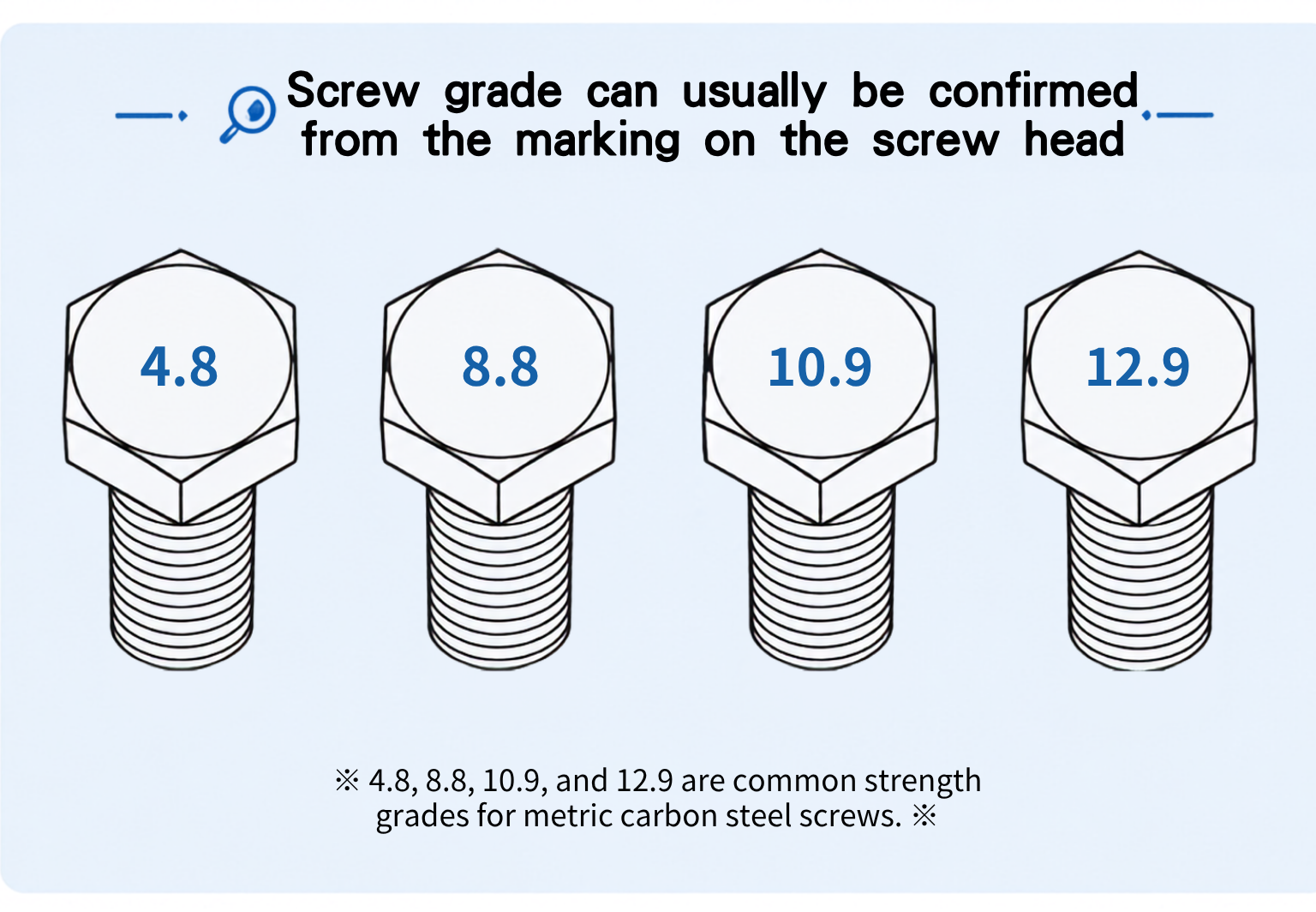
Screw grade can usually be confirmed from the marking on the screw head
Generally speaking, a higher screw grade usually indicates that the screw material has higher strength and load-bearing capability. However, this does not mean that a higher torque can be directly applied in all situations. During actual fastening operations, factors such as the material being fastened, nut, washer, thread condition, lubrication conditions, and manufacturer specifications must still be considered.
It should be noted that different screw materials and specifications may use different performance marking systems. If there is no marking on the screw head, or if the screw material and grade cannot be confirmed, it is recommended to first check the product specifications, maintenance manual, or engineering documentation.
What Do 4.8, 8.8, 10.9, and 12.9 Represent?
The two numbers in a screw grade marking are not random markings; they are related to the mechanical strength of the screw.
For common metric carbon steel screws, they can be understood in the following way:
The first number is generally related to the tensile strength of the screw.
The second number is generally related to the ratio between the yield strength and tensile strength.
※Tensile strength can be understood as the maximum pulling force a screw can withstand before breaking; yield strength is the critical point where a screw begins to undergo permanent deformation. In other words, a screw does not necessarily need to break to be considered failed. If the yield strength is exceeded during fastening, the screw may already have undergone irreversible deformation, affecting fastening stability.※
For example, an 8.8 screw can be simply understood as:
The first 8 represents a tensile strength of approximately 800 MPa.
The second 8 represents a yield strength of approximately 80% of the tensile strength.
Therefore, the yield strength concept of an 8.8 screw is approximately:
800 × 0.8 = 640 MPa
Simply put, the material strength of an 8.8 screw is generally higher than that of a 4.8 screw; 10.9 and 12.9 are higher strength grades of screws.
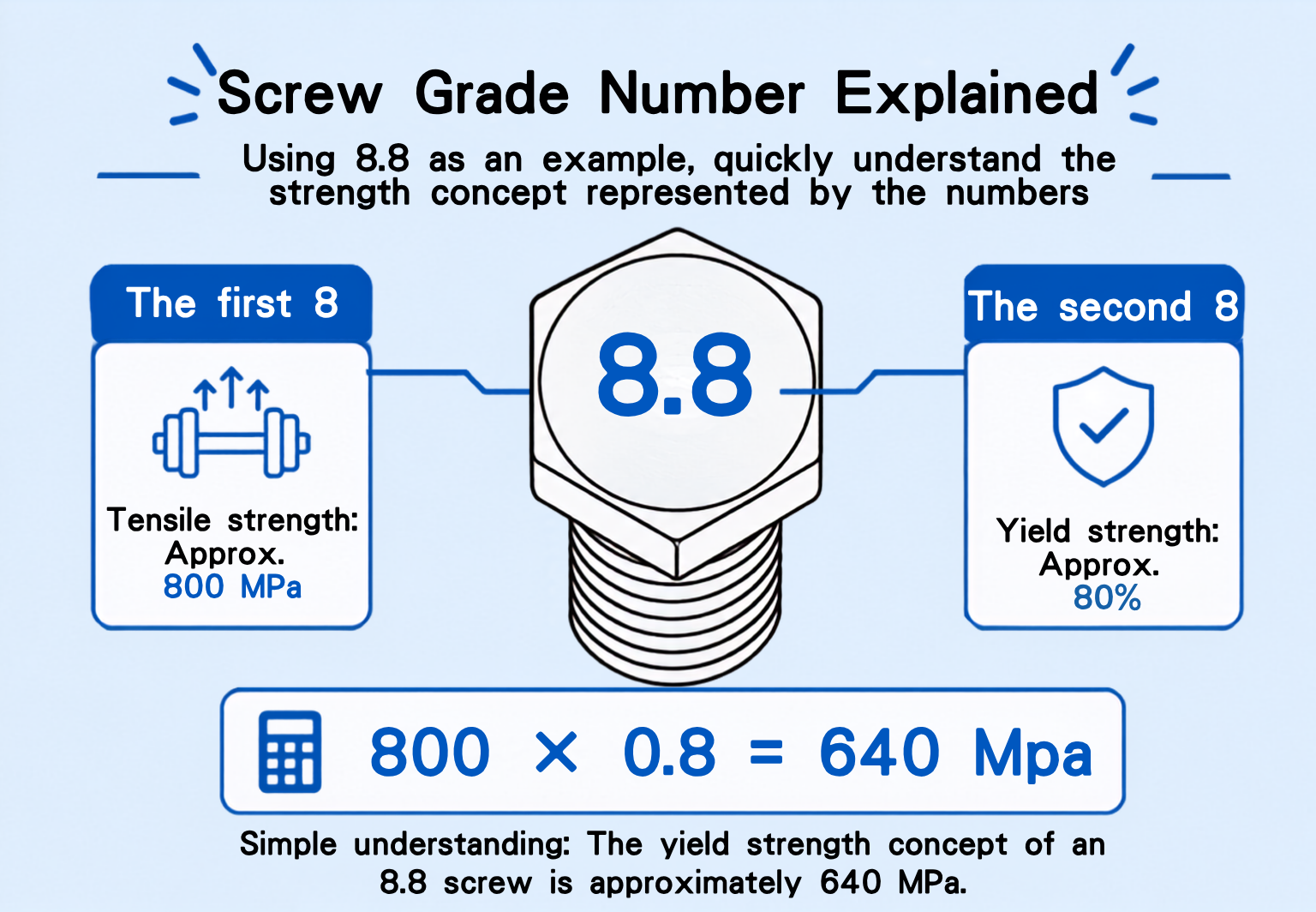
How to Read Screw Grade Numbers
| Screw Grade | Tensile Strength Concept | Yield / Proof Strength Concept | Simple Explanation |
|---|---|---|---|
| 4.8 | Approx. 400 MPa | Approx. 320 MPa | General strength screws, commonly used in low to medium load applications |
| 8.8 | Approx. 800 MPa | Approx. 640 MPa | Common high-strength screws with a wide range of applications |
| 10.9 | Approx. 1000 MPa | Approx. 900 MPa | Higher-strength screws, commonly used in higher load or mechanical applications |
| 12.9 | Approx. 1200 MPa | Approx. 1080 MPa | Higher-strength screws requiring special attention to specifications and matching conditions during use |
The above values are provided as a conceptual reference for understanding screw grades. Actual mechanical performance should still be determined according to product specifications, standard requirements, and application conditions.
Why Do Screws with the Same M8 Size Have Different Recommended Torque Values for Different Grades?
Screw torque values are not determined only by size. Taking an M8 screw as an example, M8 represents the metric size of the screw. However, even if both screws are M8, different screw grades mean different material strength capabilities, resulting in different recommended torque values.
Simply put:
Screw size affects the thread size and load-bearing area.
Screw grade affects the strength that the screw material can withstand.
Therefore, when checking a torque table, both conditions must be confirmed in order to find the corresponding recommended torque value.
If you only check M8 without confirming the screw grade, an incorrect torque setting may be applied. Insufficient torque may cause the screw to loosen; excessive torque may damage the threads, break the bolt, or damage components.
Does a Higher Screw Grade Mean It Can Always Be Tightened More?
Not necessarily.
A higher screw grade generally means that the screw material has higher strength, but this does not mean that the torque can be increased arbitrarily in all situations. Screw fastening depends not only on the screw itself, but also on the entire fastening structure. If the material being fastened is softer, the nut strength is insufficient, the thread condition is poor, or the operating environment is unsuitable, even the use of high-grade screws may cause thread damage, component deformation, bolt breakage, or fastening failure. In addition, high-strength screws may require stricter usage conditions and fastening specifications under certain circumstances. For applications such as automotive repair, mechanical equipment, structural fastening, or safety-critical areas, the equipment manufacturer′s maintenance manual, engineering drawings, or design specifications should be followed rather than simply assuming that "higher grade means safer."
Why Do You Need to Confirm Both Size and Grade When Checking a Torque Table?
As mentioned in the previous article, when checking a screw grade torque table, you need to first confirm the screw size, then confirm the screw grade, and finally confirm whether the torque unit matches the tool. The point to add in this article is: size and grade represent different information, and neither one can be considered alone. Screw sizes, such as M6, M8, and M10, are mainly used to confirm the screw specifications and dimensions; screw grades, such as 8.8, 10.9, and 12.9, are used to determine the strength classification of the screw itself.
In other words, the size determines which row to check, while the grade determines which column to check. Therefore, when checking a torque table, you cannot only confirm "how large the screw is"; you must also confirm "what strength grade the screw is." After finding the recommended torque value, check whether the table unit matches the torque tool being used in order to correctly set the tool.
Choose the Proper Torque Tool for More Accurate Fastening
After understanding the screw size and strength grade, the next step is to select the appropriate tool according to the required torque value. During manual fastening, relying only on experience and hand feeling makes it difficult to accurately control the actual applied torque. Using a torque wrench allows fastening according to the preset value, reducing the risk of over-tightening or insufficient tightening.
When selecting a torque wrench, confirm:
✅ Whether the torque range of the tool meets the requirements
✅ Whether the torque unit is consistent (N·m, ft·lb, etc.)
✅ Whether the drive size meets the operation requirements
Using the correct torque tool not only improves fastening accuracy but also makes work efficiency more stable.
Frequently Asked Questions FAQ
Q1: Are screw grades 8.8, 10.9, and 12.9 screw sizes?
No. 8.8, 10.9, and 12.9 are screw strength grades, not screw sizes. Screw sizes are usually represented as M6, M8, M10, etc., while screw grades are used to indicate the material strength classification of the screw.
Q2: Does a higher screw grade always mean it is better?
Not necessarily. Higher-grade screws usually indicate higher material strength, but whether they are suitable for use still depends on the fastening location, the material being fastened, nut grade, thread condition, and manufacturer specifications. A higher grade should not be directly substituted or used as a reason to increase torque.
Q3: Can an 8.8 screw be directly replaced with a 12.9 screw?
Direct replacement is not recommended. Screws of different grades may have different strength, ductility, and fastening requirements. If changing the screw grade, first confirm the equipment design requirements, nut compatibility, material being fastened, and manufacturer specifications.
Q4: What should I do if there is no grade marking on the screw head?
If the screw grade cannot be confirmed, it is recommended not to directly apply the torque value of a high-strength screw. Confirm the product information, specification sheet, or original maintenance manual before fastening.
Q5: After finding the screw grade, can I directly set the torque?
Not yet. In addition to the screw grade, you must also confirm the screw size, torque unit, thread condition, lubrication conditions, and operating environment. For important fastening operations, the torque should be set according to the original maintenance manual or engineering specifications.
Conclusion: Understanding Screw Grades Helps You Check the Correct Torque Value
Screw grade is important information for determining screw strength. When checking a torque table, if you only look at the screw size and ignore the screw grade, you may find an unsuitable recommended torque value. The correct method is to first confirm the screw size, then confirm the screw grade, and check whether the torque unit matches the tool. For applications such as automotive repair, mechanical equipment, structural fastening, or safety-critical areas, the original maintenance manual or engineering specifications should still be followed.
Understanding screw grades and checking the correct torque value can make fastening operations more stable and reliable. Enjoy Your Work.
Welcome to Torque Unit Conversion for Screw Grades to learn more~
Recommended Products
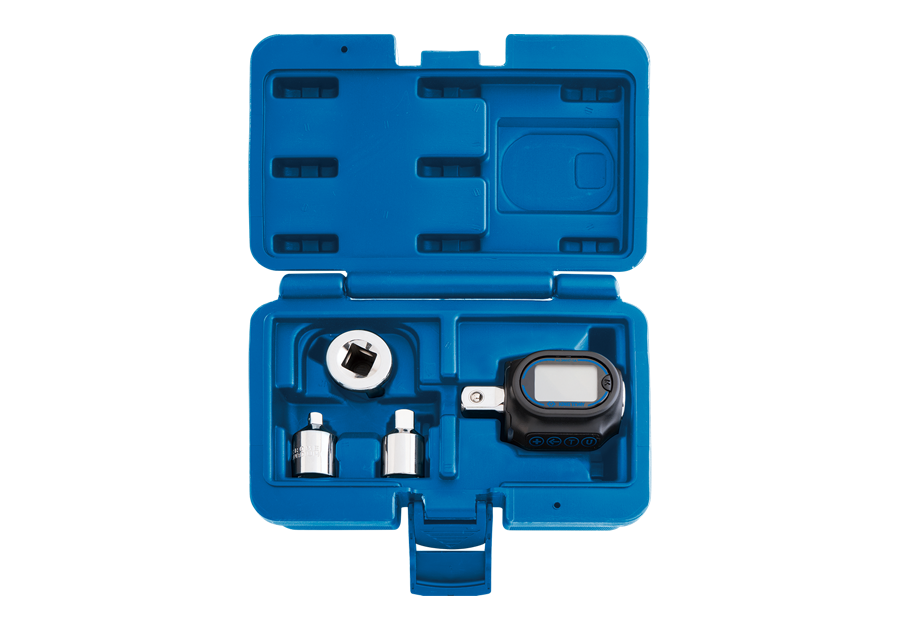
Digital Angle Adapter
34417-1A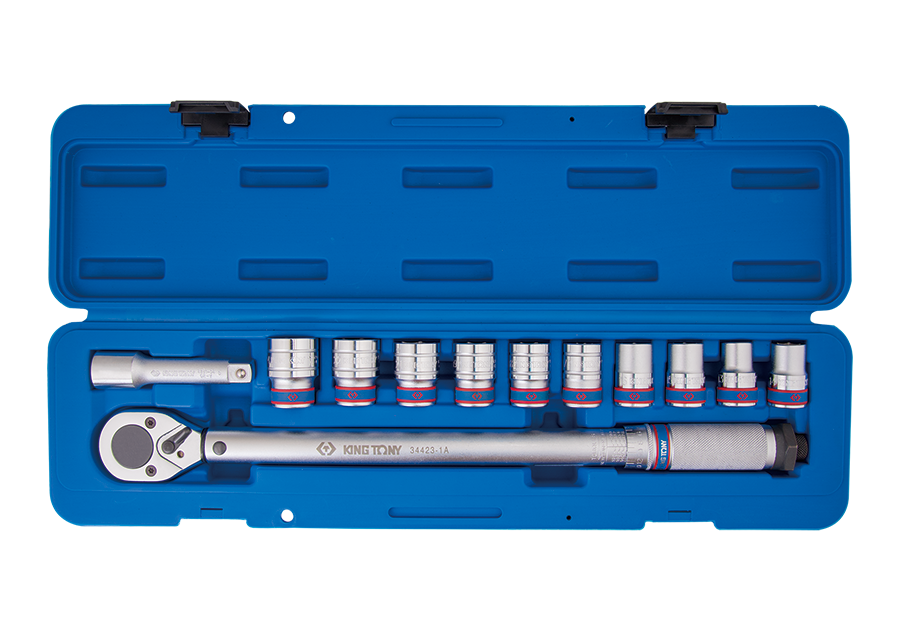
12 PC. Adjustable Torque Wrench Set
344251A12MR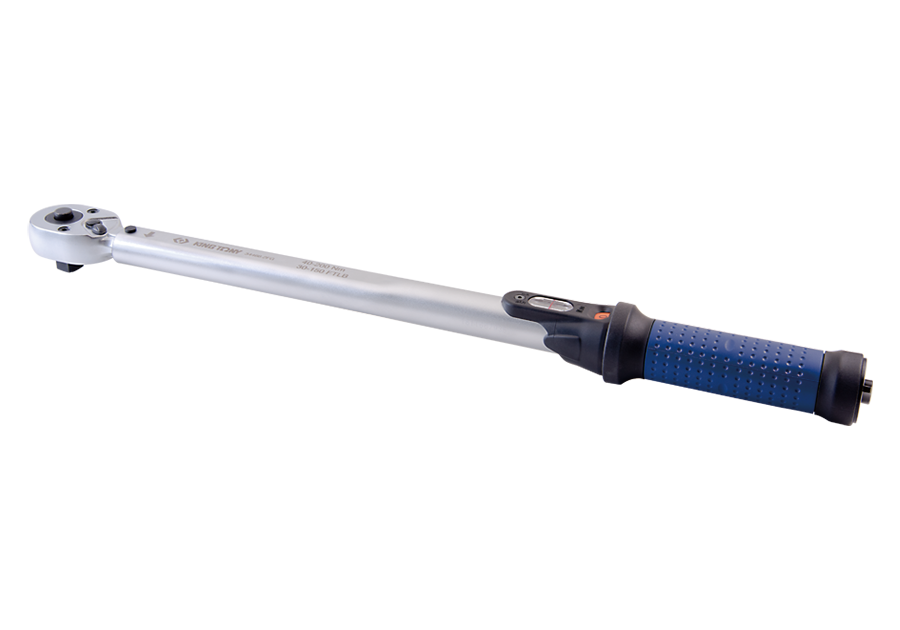
Window Type Adjustable Torque Wrench (Newton Meter & English)
34466-FG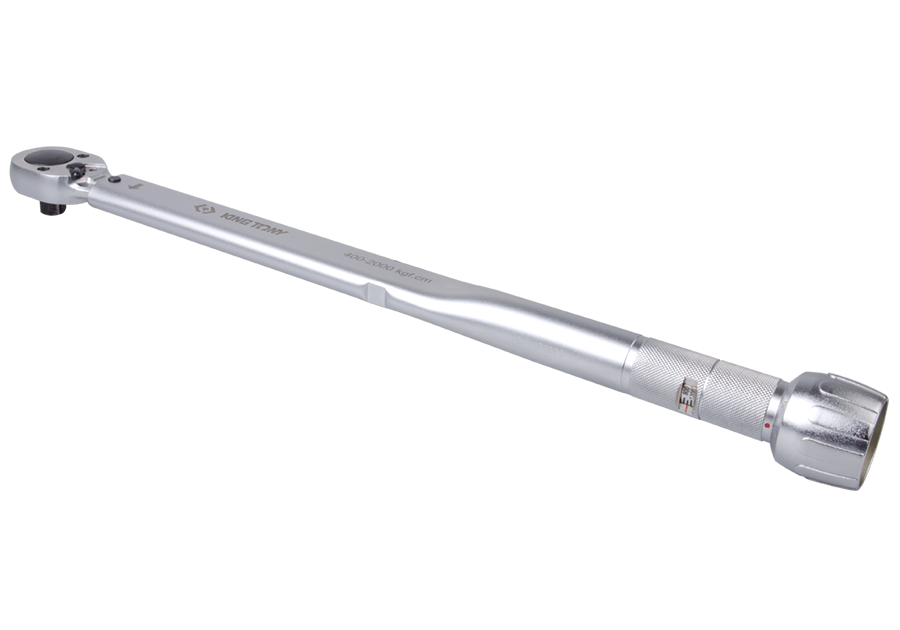
Click Type Adjustable Torque Wrench (Kilogram)
3442F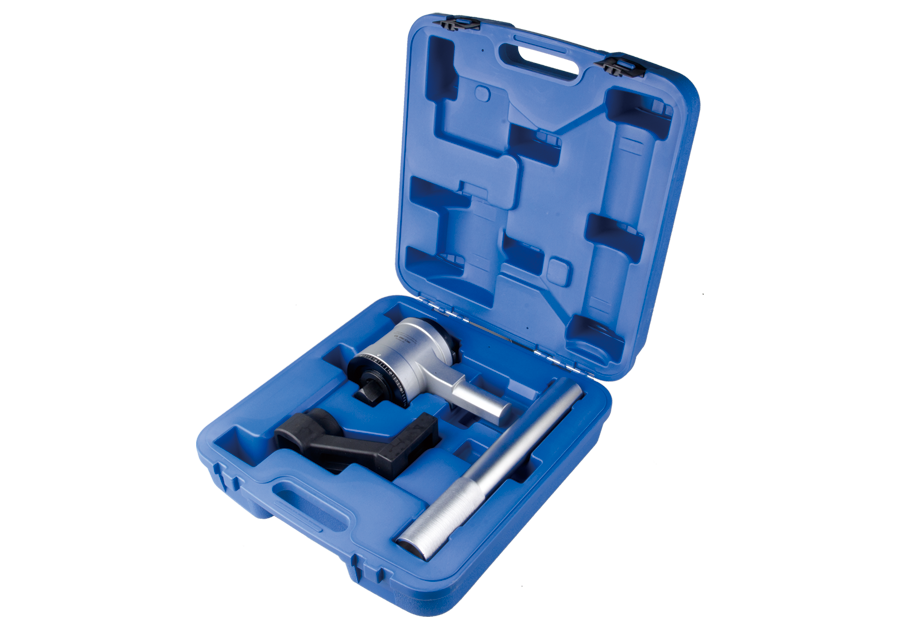
Torque Multiplier(1/2"F x 1"M)
34488-26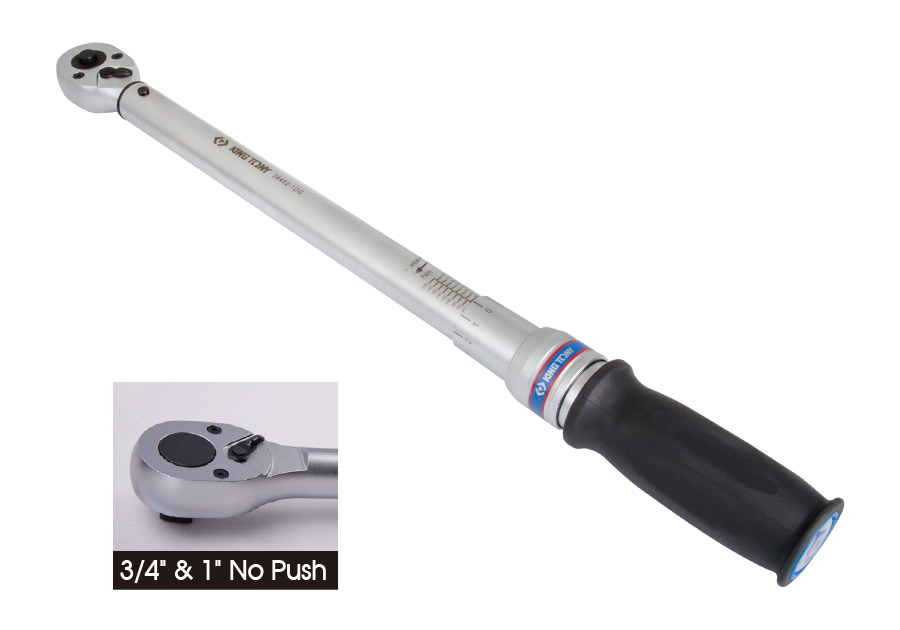
Heavy Duty Adjustable Torque Wrench (Newton Meter)
34462-DG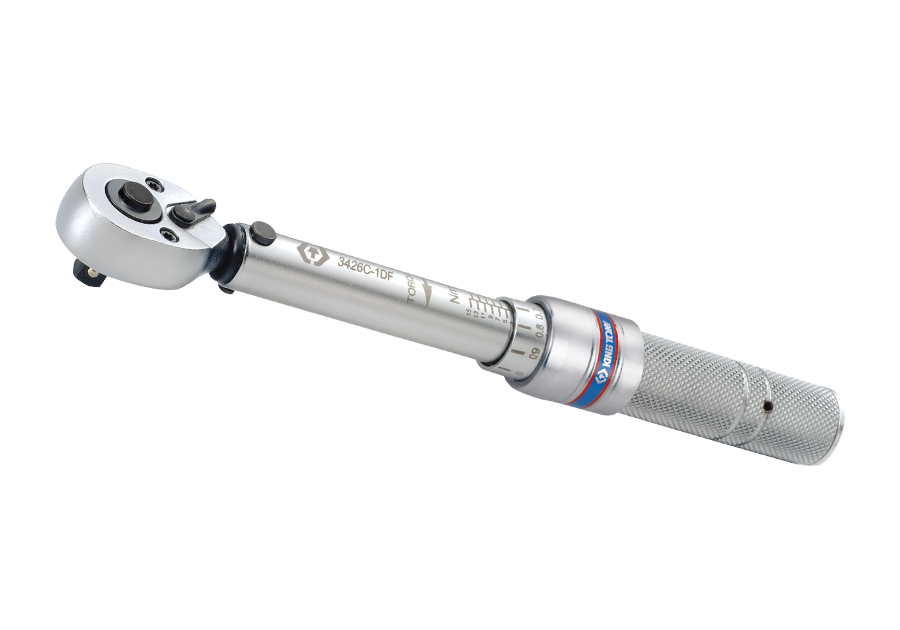
Mini-type Heavy Duty Torque Wrench (Newton Meter)
3426C-DF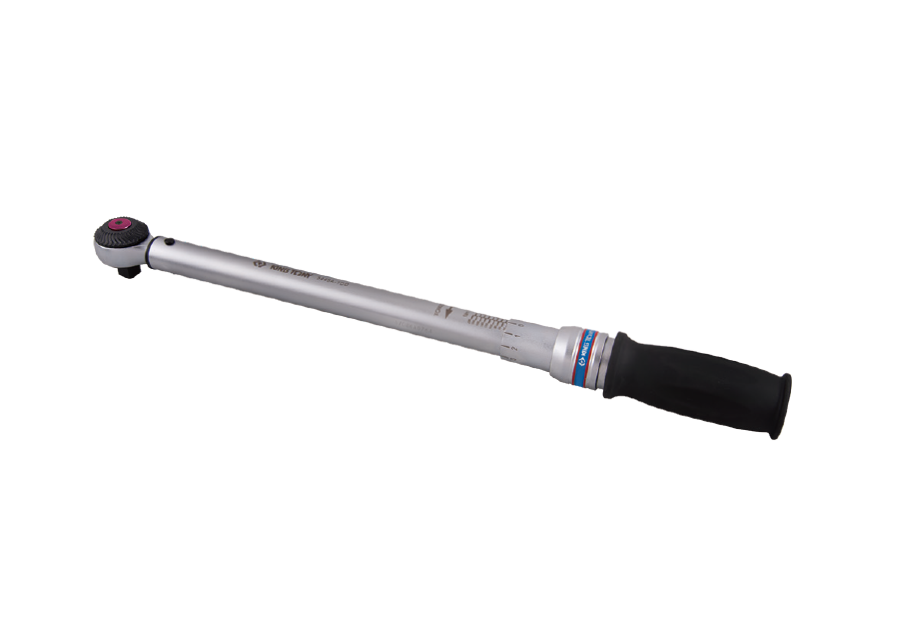
72PT Heavy Duty Adjustable Torque Wrench (Newton Meter)
3446A-DG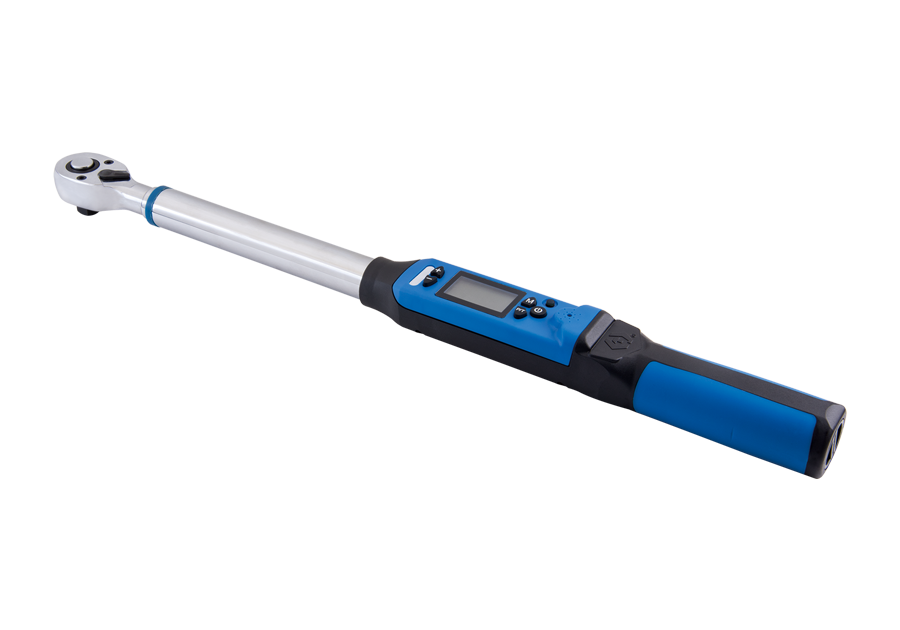
Electronic Torque Wrench
34467-AG